Home
About Us
Products
Process Models
SE Resources
Commentary
Contact us
|
|
|
Breaking News!
A new blog ...
Dlink 2750u Firmware Update ((top)) -
Before embarking on an update, careful preparation is essential. The process is unforgiving: an interruption during the flashing stage can "brick" the router, turning it into an expensive paperweight. First, identify the exact hardware version of your 2750u, printed on a sticker on the device’s underside (e.g., A1, B1, C1). Firmware is not interchangeable between hardware revisions. Second, acquire the correct firmware file exclusively from a trusted source—ideally the original D-Link support site or your ISP’s official portal. Third, connect your computer to the router via an Ethernet cable; Wi-Fi is too unstable for firmware updates. Finally, perform a factory reset to clear any conflicting settings, and disable your computer’s firewall and antivirus temporarily to prevent interference.
In the rapidly evolving world of networking technology, older devices like the D-Link DSL-2750u often find themselves relegated to closets or landfill sites. However, for users in regions where ADSL2+ remains a primary broadband access method, or for those seeking a inexpensive router for basic tasks, this device still holds value. Central to maintaining its functionality, security, and stability is the often misunderstood process of firmware updating. Updating the firmware on a D-Link 2750u is not merely about chasing new features; it is a critical maintenance task that can breathe new life into aging hardware. dlink 2750u firmware update
The actual update procedure for the D-Link 2750u is straightforward but demands patience. After logging into the router’s web interface (typically at 192.168.1.1 ), navigate to the "Maintenance" or "Tools" section, then select "Firmware Update" or "Software Upgrade." Click "Browse" to select the downloaded .bin or .img file and initiate the upload. The router will take two to three minutes to erase the old firmware and write the new one. During this time, do not power cycle the device, close the browser, or disconnect the cable. Once completed, the router will reboot automatically. After the reboot, perform another factory reset to clear residual old settings, then reconfigure your ISP connection details (VPI/VCI values, PPPoE username/password) from scratch. Before embarking on an update, careful preparation is
The primary motivation for updating the firmware of the D-Link 2750u should be security and stability. Manufacturers release firmware updates to patch known vulnerabilities, fix bugs that cause random disconnections, and improve compatibility with Internet Service Provider (ISP) infrastructure. An outdated router can be a gateway for cyber threats, as unpatched exploits allow attackers to hijack DNS settings or intercept traffic. For the 2750u, a device that has long been end-of-life (EOL) by D-Link, official updates are scarce. Nevertheless, users with specific ISP-branded versions (such as those from Telkom or Beeline) might find targeted updates that resolve line synchronization issues or improve Wi-Fi radio stability. Firmware is not interchangeable between hardware revisions
It is crucial to temper expectations with realism. Since the D-Link 2750u is a legacy ADSL modem-router, its last official firmware updates likely date back to 2014–2016. Users should not expect modern features like WPA3 security, mesh networking, or IPv6 advancements. In fact, attempting to flash unofficial or modified firmware from unreliable sources poses a significant risk. For most users, if the current firmware is stable and the device is isolated from the public internet (e.g., behind a modern firewall router), the old adage "if it ain’t broke, don’t fix it" applies strongly.
In conclusion, updating the firmware on a D-Link 2750u is a delicate but worthwhile endeavor for those wishing to maximize the lifespan of their legacy hardware. It can resolve persistent bugs and plug security holes, provided the user meticulously follows preparation steps and uses authentic files. However, the update is not a cure-all for obsolescence. Given the device’s age and the cessation of official support, the most prudent long-term strategy might be to replace the 2750u with a modern VDSL or fiber-ready router. Until then, a successful firmware update remains a testament to the principle that with careful attention, older technology can continue to serve reliably in the right environment. |
|
|
|
|
|
|
|
|
|
|
|
|
|
|
| The newest edition! |
|
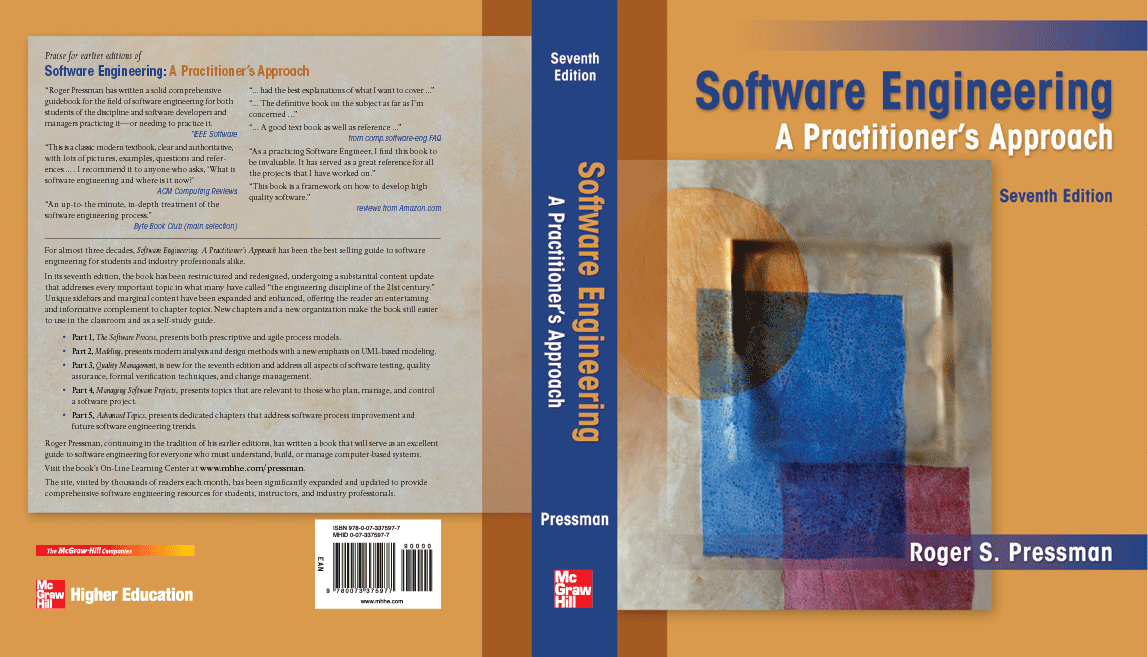 |
Another novel by
Roger Pressman! |
|
 |
|
|
|
|
|
Available in trade paperback and e-book editions. For more information, click here. |
|
|
|
|
|
|
|
|
|
|
The seventh edition of Software Engineering: A Practitioner's Approach is intended to serve as a guide to a maturing engineering discipline. The seventh edition, like the six editions that preceded it, is intended for both students and practitioners, retaining its appeal as a guide to the industry professional and a comprehensive introduction to the student at the upper level undergraduate or first year graduate level.
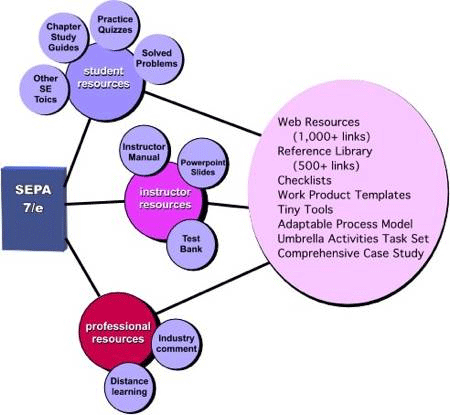
The seventh edition is considerably more than a simple update. The book has been revised and restructured to improve pedagogical flow and emphasize new and important software engineering processes and practices. In addition, a revised and updated “support system,” illustrated below, provides a comprehensive set of student, instructor, and professional resources to complement the content of the book.
|
|
|
|
 |
|
|
The 32 chapters of the seventh edition have been reorganized into five parts. This organization, which differs considerably from the sixth edition, has been done to better compartmentalize topics and assist instructors who may not have the time to complete the entire book in one term.
Part 1, The Process, presents a variety of different views of software process, considering all important process models and addressing the debate between prescriptive and agile process philosophies. Part 2, Modeling, presents analysis and design methods with an emphasis on object-oriented techniques and UML modeling. Pattern-based design and design for Web applications are also considered. Part 3, Quality Management, presents the concepts, procedures, techniques, and methods that enable a software team to assess software quality, review software engineering work products, conduct SQA procedures, and apply an effective testing strategy and tactics. In addition, formal modeling and verification methods are also considered. Part 4, Managing Software Projects, presents topics that are relevant to those who plan, manage, and control a software development project. Part 5, Advanced Topics, considers software process improvement and software engineering trends. Continuing in the tradition of past editions, a series of sidebars is used throughout the book to present the trials and tribulations of a (fictional) software team and to provide supplementary materials about methods and tools that are relevant to chapter topics. Two new appendices provide brief tutorials on UML and object-oriented thinking for those who may be unfamiliar with these important topics.
The five-part organization of the seventh edition enables an instructor to "cluster" topics based on available time and student need. An entire one-term course can be built around one or more of the five parts. A software engineering survey course would select chapters from all five parts. A software engineering course that emphasizes analysis and design would select topics from Parts 1 and 2. A testing-oriented software engineering course would select topics from Parts 1 and 3, with a brief foray into Part 2. A "management course" would stress Parts 1 and 4. By organizing the seventh edition in this way, I have attempted to provide an instructor with a number of teaching options. |
|
|
Software Engineering: A Practitioner's Approach
7th Edition
Table of Contents
Chapters
1. Software and Software Engineering
Part I - Process
2. Process Models
3. Agile Development
Part II - Modeling
4. Practice: A Generic View
5. Understanding Requirements (new chapter)
6. Requirements Modeling: Scenarios and Data (new chapter)
7. Requirements Modeling: Flow, Classes, and Behavior (new chapter)
8. Design Concepts (new chapter)
9. Architectural Design
10. Component-Level Design
11. Usability design (new chapter)
12. Pattern-based Design (new chapter)
13. WebApp Design
Part III - Quality Management
14. Quality Concepts (new chapter)
15. Software reviews (new chapter)
16. Software Quality Assurance
17. Software Testing Strategies
18. Testing Methods for Conventional Software (new chapter)
19. Testing Methods for OO Software (new chapter)
20. Testing Methods for WebApps
21. Advanced Verification Methods (new chapter)
22. Software Configuration Management
23. Product Metrics
Part IV - Project Management
24. Management Concepts
25. Process and Project Metrics
26. Estimation
27. Scheduling
28. Risk Management
29. Maintenance and Reengineering (new chapter)
Part V-Advanced Topics
30. Software Process improvement (new chapter)
31. Emerging Trends in Software Engineering (new chapter)
32. The Road Ahead
Appendix I - UML Tutorial (new)
Appendix II - OO Concepts (new)
|
|
|
|
|
|
|
|
|
Home About us Products Product Models SE Resources Commentary Contact us
Web site and all contents © 2001-2009, R.S. Pressman & Associates, Inc., All rights reserved.
Free website templates
|
|